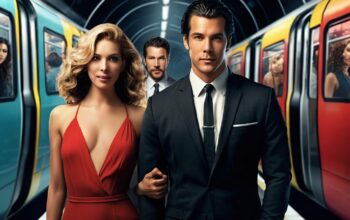
The concept of a Time Loop Metro presents a fascinating exploration of science fiction narratives, blending urban infrastructure with intricate temporal puzzles. This idea captures the imagination, conjuring images of trains endlessly cycling through dimensions, looping time in a dance orchestrated underground.
“Science fiction has always provided a fertile ground for the imagination to run wild, reaching beyond the stars and bending the rules of reality itself.” – Isaac Asimov
Origins of the Concept
The idea of metro systems that loop through time rather than simply space is not new, but it finds unique expression in contemporary literature and media, often influenced by earlier works of speculative fiction. The notion plays on familiar urban experiences—the daily commute—and escalates them into thrilling metaphysical adventure.
Key Influences in Literature
- H.G. Wells’ “The Time Machine” – Although Wells’s work primarily concerns travel through time rather than loops, it sets a precedent for narratives where technology manipulates temporal perception.
- Jorge Luis Borges – Known for his labyrinthine stories, Borges’ work often blurs the lines of time and reality, providing a profound influence on the concept of places that defy temporal logic.
- China Miéville’s “The City & the City” – Miéville introduces readers to cities that overlap spatially and culturally, inspiring thoughts of metros intersecting not just space, but time itself.
Plot Mechanics and Symbolism
The Time Loop Metro often serves as a metaphor for life’s repetitive patterns, a symbol of existential ennui, or a plot device for characters seeking escape or enlightenment. In these narratives, characters could experience moments repeatedly until they achieve a deeper understanding, similar to the mythical Eternal Return.
- Thought Experiments – These narratives invite audiences to consider the effects of altering a single moment repeatedly. How does it impact the broader tapestry of time?
- Symbol of Modern Life – The metro operates as a backdrop amplifying the stresses and reflections of modern living, as commuters are literally trapped in a time loop.
“We have all experienced déjà vu. The feeling that you’ve been here before. Science fiction takes this a step further with time loops, questioning reality itself.” – Neil Gaiman
Technological Enablers
The Time Loop Metro isn’t just a fantasy; it’s a representation of technological possibilities that tantalize with potential yet-to-be-realized:
- Automated Systems – The advent of AI-driven transit systems could theoretically allow for precise temporal adjustments, looping back moments as part of their algorithmic models.
- Magnetic Levitation – Maglev trains, already existing in science fiction and reality, could be imagined to harness gravitational forces to loop through time.
Such speculative elements push the boundaries of what’s technologically conceivable, offering narratives rich with futuristic promise and philosophical inquiry.
Cinema and Television Adaptations
The allure of time loop narratives naturally extends to visual media, allowing for visually stunning depictions and intricate storytelling:
- “Palm Springs” (2020) – Although not directly involving a metro, the film explores time loops in a contemporary setting, focusing on character development within repetitive circumstances.
- “Doctor Who” – With its iconic time-traveling TARDIS and episodes like “The Time of the Doctor,” this series often plays with looping narratives and resonances with human experiences.
The Philosophical Undercurrents
The time loop concept resonates with philosophical queries. Is time linear or cyclical? Are our lives predestined, or can they change due to singular actions repeated over numerous iterations?
“To loop through time is to question the linearity of our reality, to envision what it might mean to truly change one’s life and oneself.” – Philip K. Dick
Time loops challenge our perceptions of causality and free will, questioning the very essence of human experience in their journey through underground circuits.
Conclusion: The Journey’s End
The Time Loop Metro is more than a science fiction trope; it speaks to our deepest fears and hopes. It is a symbol of both entrapment and potential liberation, of confronting the self within the spans of a vast and looping universe. Through its speculative lens, we gain insights into the possibilities of technology and the complexities of human consciousness.
As we step aboard our daily trains, perhaps we imagine for a moment the possibilities of a Time Loop Metro, where each stop might carry us not just to a different place, but to a different time.